



High Impact Polystyrene (HIPS) sheet is one of the most widely specified rigid thermoplastics in global manufacturing — prized for its balance of impact strength, processability, and cost efficiency. This guide examines its chemistry, technical parameters, grade variants, comparative positioning, and the industries that rely on it every day.
1. What Is High Impact Polystyrene (HIPS)?
High Impact Polystyrene is produced by blending polybutadiene rubber into a polystyrene matrix during polymerization. This rubber-toughening mechanism interrupts crack propagation paths at the microscopic level, dramatically increasing the energy required to fracture the material compared with general-purpose polystyrene (GPPS). The result is a rigid, opaque thermoplastic that is simultaneously tough, lightweight, and economical to process at scale.
Unlike crystal-clear GPPS, HIPS carries a naturally matte or semi-gloss white appearance in its natural state, though it accepts pigment readily and is commonly supplied in a full spectrum of custom colors. Its density sits at approximately 1.06 g/cm³ — meaningfully lower than ABS — making it a preferred choice wherever weight reduction matters without sacrificing panel rigidity.
Key chemistry note: The polybutadiene rubber phase disperses as microscopic particles throughout the polystyrene matrix. Under stress, these particles crazes and shear-yield, absorbing impact energy before macroscopic cracking can occur — the core mechanism behind the "high impact" designation.
2. Technical Specifications & Product Parameters
Haining Hongkai Technology Co., Ltd. manufactures HIPS plastic sheets across three primary grades — Conductive, Anti-Static, and Normal — each engineered for distinct end-use environments. The table below summarizes the core product parameters as measured to factory tolerance standards.
| Parameter | Conductive Grade | Anti-Static Grade | Normal Grade |
|---|---|---|---|
| Density (±0.02) | 1.06 g/cm³ | 1.06 g/cm³ | 1.06 g/cm³ |
| Thickness (±0.015 mm) | 0.2 mm – 2.0 mm | 0.2 mm – 2.0 mm | 0.2 mm – 2.0 mm |
| Surface Resistance (Ω) | 10⁴ – 10⁶ | 10⁹ – 10¹¹ | ≥ 10¹² |
| Max. Roll Width (±1.0 mm) | 640 mm | 640 mm | 640 mm |
| Max. Roll Weight (±0.5 kg) | 250 kg | 250 kg | 250 kg |
| Typical Primary Use | ESD-sensitive electronics trays | Component packaging; cleanrooms | Food, pharma, signage, general thermoforming |
The three-grade system allows procurement teams to specify exactly the electrostatic performance required by their process — from fully insulating food-grade packaging all the way down to low-resistance trays for handling bare semiconductor devices.
3. Key Material Properties
Understanding the full property profile of HIPS sheet is essential for material selection. The table below provides a generalized mechanical and thermal reference consistent with standard commercial HIPS grades at 1.06 g/cm³ density.
| Property | Typical Value | Test Standard (ref.) |
|---|---|---|
| Density | 1.04 – 1.08 g/cm³ | ISO 1183 |
| Tensile Strength | 25 – 40 MPa | ISO 527 |
| Elongation at Break | 20 – 50% | ISO 527 |
| Flexural Modulus | 1,700 – 2,500 MPa | ISO 178 |
| Izod Impact (notched) | 60 – 130 J/m | ISO 180 |
| Vicat Softening Point | 85 – 100 °C | ISO 306 |
| Thermal Conductivity | ~0.17 W/(m·K) | ISO 8302 |
| Mold Shrinkage | 0.2 – 0.6% | ISO 294-4 |
| Flammability (standard) | HB (self-extinguishing grades available) | UL 94 |
| Water Absorption (24 hr) | < 0.1% | ISO 62 |
HIPS's low water absorption makes it dimensionally stable in humid environments — a critical advantage for refrigerated food packaging and cold-chain logistics. Its mold shrinkage is tightly controlled, ensuring consistent wall thickness and dimensional accuracy across thermoformed production runs.
4. Understanding the Three HIPS Grades
Normal Grade
- Surface resistance ≥ 10¹² Ω (fully insulating)
- Food-contact hygienic; SGS certified
- Ideal for thermoformed yogurt cups, trays, blister packs
- Widest color & thickness range
- Recyclable under standard PS streams
Anti-Static Grade
- Surface resistance 10⁹ – 10¹¹ Ω
- Prevents dust attraction on finished parts
- Suitable for cleanroom component trays
- Pharmaceutical & medical tray applications
- Reduces triboelectric charge in high-speed forming
Conductive Grade
- Surface resistance 10⁴ – 10⁶ Ω
- Full ESD protection for sensitive electronics
- Used in carrier tape sheets
- JEDEC / ANSI ESD S20.20 alignment
- Critical for IC chip, PCB, and LED component trays
5. Processing & Fabrication Characteristics
One of HIPS sheet's greatest commercial strengths is its excellent processability. Its forming temperature range — typically between 130 °C and 180 °C — is narrower and lower than ABS, translating directly into shorter cycle times and reduced energy costs in high-volume thermoforming operations.
Thermoforming
HIPS responds predictably to both pressure forming and vacuum forming. Its consistent melt viscosity at processing temperatures allows fine-detail reproduction of mold geometry, which is why it dominates disposable food tray and pharmaceutical blister production. Cycle speeds in continuous roll-fed thermoforming lines can exceed 600 cycles per hour for thin gauges (0.2 – 0.5 mm).
Cutting, Routing & Printing
HIPS sheet cuts cleanly with standard carbide-tipped tooling and accepts both solvent-based and UV-curable screen printing inks without surface priming in most formulations. This makes it a go-to substrate for point-of-sale retail displays and promotional signage where high-quality graphics are required at competitive cost.
| Operation | Typical Temperature / Condition | Notes |
|---|---|---|
| Thermoforming (vacuum) | 140 – 170 °C sheet surface | Pre-dry if stored in humid conditions (> 65% RH) |
| Thermoforming (pressure) | 150 – 180 °C sheet surface | Finer detail; higher mold pressure required |
| Extrusion temperature | 180 – 240 °C (barrel zones) | Applied during manufacturing, not end-user forming |
| Mold temperature | 20 – 60 °C | Lower mold temp for faster cycle; higher for clarity |
| Screen printing cure (UV) | Ambient; UV lamp pass | No primer required on most formulations |
| CNC routing feed rate | 4,000 – 8,000 mm/min (typical) | Carbide end mills; air or mist cooling recommended |
6. Industrial Applications of HIPS Sheet
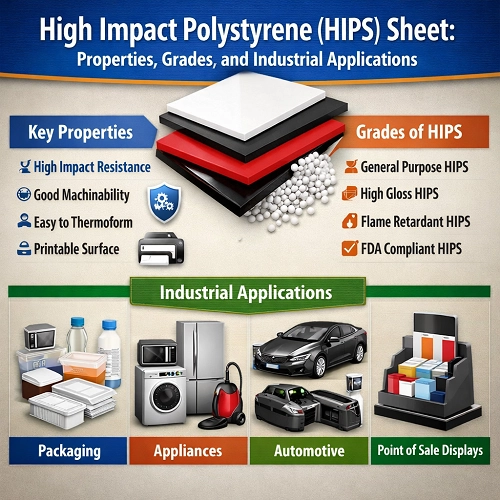
The application landscape for HIPS sheet spans virtually every major manufacturing sector. Below is a structured overview of primary markets and the specific roles HIPS plays within each.
| Industry Sector | Typical Products | Grade Required | Key Performance Driver |
|---|---|---|---|
| Food & Beverage Packaging | Yogurt cups, deli trays, cold-chain containers | Normal | Food-contact compliance, hygienic surface |
| Electronics Manufacturing | IC component trays, carrier tapes, reel covers | Conductive / Anti-Static | ESD protection, dimensional accuracy |
| Pharmaceutical & Medical | Blister packaging, instrument trays, sterile housings | Normal / Anti-Static | Hygiene, stiffness, printability |
| Printing & Retail Signage | POS displays, shelf talkers, promotional boards | Normal | Printability, smooth surface, machinability |
| Consumer Goods | Toy housings, stationery, appliance panels | Normal | Cost efficiency, impact resistance, colorability |
| Industrial | Machine guards, protective liners, structural panels | Normal | Rigidity, dimensional stability, ease of fabrication |
| Dairy & Cold Chain | Refrigerated food trays, beverage cups | Normal | Low-temp impact retention, moisture resistance |
7. HIPS vs. ABS and APET: Material Selection Guide
Selecting the correct thermoplastic sheet requires understanding how HIPS compares to alternative materials. The most frequent comparisons in industrial procurement are against ABS plastic sheet and APET plastic film — both of which Haining Hongkai Technology also manufactures.
| Criterion | HIPS | ABS | APET |
|---|---|---|---|
| Density (g/cm³) | 1.04 – 1.08 | 1.02 – 1.08 | 1.33 – 1.40 |
| Impact Resistance | Good | Very Good | Moderate |
| Optical Clarity | Opaque | Opaque | Excellent (crystal clear) |
| Thermoforming Ease | Excellent | Good | Good |
| Max. Service Temp. | ~80 °C | ~90 °C | ~70 °C |
| Printability | Excellent | Very Good | Good (corona-treated) |
| Food-Contact Grade | Yes | Limited | Yes |
| Recyclability | Yes (PS #6) | Yes (ABS) | Yes (PET #1) |
| Raw Material Cost | Low | Medium | Medium |
| ESD Grades Available | Yes | Yes | Limited |
In summary: HIPS is the preferred choice when cost efficiency, printability, and thermoforming speed are primary. ABS outperforms HIPS at elevated service temperatures and where higher surface hardness is needed. APET is the material of choice when optical clarity or direct food contact in high-temperature environments is required.
8. Environmental Profile & Sustainability
HIPS sheet carries a favorable sustainability profile relative to many competing rigid plastics. Under standard thermoplastic recycling infrastructure, HIPS is classified as resin code #6 (PS) and can be collected, reprocessed, and re-extruded into secondary products. Haining Hongkai Technology's manufacturing process is certified to ISO 14001, the international standard for environmental management systems, ensuring that production waste, emissions, and energy use are systematically controlled and continuously improved.
From an end-of-life perspective, HIPS does not produce environmentally hazardous byproducts upon incineration under controlled conditions — an important consideration for markets where waste-to-energy is a primary disposal route. Brands with circular economy commitments increasingly specify HIPS in food packaging designs where post-consumer recyclate (PCR) content targets must also be met.
9. Why Source HIPS Sheet from Haining Hongkai Technology?
Haining Hongkai Technology Co., Ltd. is a factory-direct wholesale manufacturer of HIPS, APET, and ABS plastic sheet materials based in Haining, Zhejiang Province, China. With over 20 years of combined R&D and commercial sales experience, the company supplies distributors, converters, and OEM manufacturers across Asia, Europe, the Middle East, and the Americas.
| Criterion | Detail |
|---|---|
| Quality Certification | ISO 9001 (quality management) & ISO 14001 (environmental management) |
| Product Certification | SGS independently tested and verified |
| Production Capacity | 700 metric tons per month |
| Thickness Range | 0.2 mm – 2.0 mm (±0.015 mm tolerance) |
| Custom Capabilities | Color, thickness, surface finish, conductive/anti-static formulation |
| Available Product Lines | HIPS Plastic Sheets, HIPS Conductive Carrier Tape Sheets, APET Film, ABS Sheet |
| Pricing Model | Factory-direct wholesale; no intermediary markup |
| Contact (Sales) | carolzhang@hnhktech.com |
The company's 700-ton monthly output provides the supply security that high-volume customers require, while its custom manufacturing capability — covering conductive, anti-static, and standard formulations in a full range of widths and colors — means that specialist converters and electronics OEMs can source to exact specification without compromise.
Request a Wholesale HIPS Sheet Quote
Whether you need standard HIPS sheets in bulk, ESD-grade conductive variants for electronics packaging, or custom color and thickness specifications, Haining Hongkai Technology delivers factory-direct, competitively priced solutions with consistent on-time delivery.
Contact Us TodayReferences & Further Reading
- Haining Hongkai Technology — HIPS Plastic Sheet Product Overview
- HIPS Plastic Sheets — Technical Specifications & Product Parameters
- HIPS Conductive Carrier Tape Sheets — ESD Packaging Grade
- APET Plastic Film — Alternative Material for Clarity-Critical Applications
- ABS Plastic Sheet — Alternative Material for High-Temperature Applications
- About Haining Hongkai Technology — Company, Certifications & Factory