



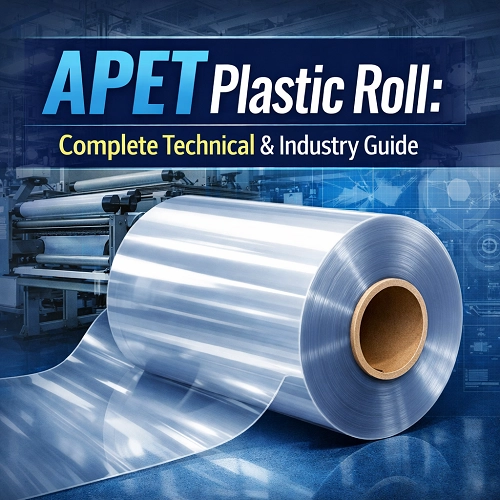
APET plastic roll — Amorphous Polyethylene Terephthalate in continuous roll form — is one of the most versatile thermoforming substrates available today. From crystal-clear food packaging to precision electronic carrier tapes, this guide covers everything procurement teams, product designers, and packaging engineers need to know: chemistry, mechanical properties, processing parameters, functional variants, sustainability credentials, and sourcing essentials.
1. What Is APET Plastic?
Polyethylene Terephthalate (PET) is a semi-crystalline thermoplastic polyester. When PET is rapidly quenched after extrusion — preventing polymer chains from aligning into ordered crystalline structures — the result is Amorphous PET (APET). This amorphous state gives APET its signature glass-like optical clarity, superior surface gloss, and excellent thermoformability that crystalline variants (C-PET) cannot match at room temperature.
APET plastic rolls are produced by melting PET resin, extruding it through a flat die, and rapidly cooling the melt on a chill roll. The continuous web is then slit and wound into rolls of specified width and length — ready for downstream thermoforming, cutting, printing, or laminating operations. Browse Hongkai's full APET product range →
2. Key Technical Properties
Understanding APET's physical and mechanical profile is essential for selecting the correct grade and thickness. The table below summarises the core parameters for standard Hongkai APET rolls:
| Property | Typical Value | Test Standard Reference |
|---|---|---|
| Density | 1.35 g/cm³ (±0.02) | ISO 1183 / ASTM D792 |
| Thickness Range | 0.2 mm – 1.3 mm (±0.015 mm) | ISO 4593 |
| Width Range | 300 mm – 1,000 mm (±1.0 mm) | Manufacturer spec |
| Roll Max. Weight | 550 kg (±0.5 kg) | Manufacturer spec |
| Light Transmittance | ≥ 88 % | ASTM D1003 |
| Haze | ≤ 2.0 % | ASTM D1003 |
| Tensile Strength (MD/TD) | ≥ 50 / 45 MPa | ISO 527-3 |
| Elongation at Break | ≥ 100 % | ISO 527-3 |
| Glass Transition Temp. (Tg) | ~75 – 80 °C | DSC |
| Thermoforming Temp. | 130 – 160 °C | Process guide |
| Food-Contact Compliance | Yes (FDA / EU 10/2011) | SGS certified |
The combination of high optical clarity (transmittance ≥ 88 %, haze ≤ 2 %) and robust mechanical strength makes APET an exceptional substrate where visual product appeal is as important as structural integrity — as in premium food trays, cosmetic blisters, and point-of-sale display covers.
3. APET Plastic Roll Variants & Functional Grades
A single material family covers a wide functional spectrum. Haining Hongkai Technology manufactures the following purpose-built grades:
Standard APET Sheet
High clarity, food-grade. Ideal for thermoformed trays, blisters, and clamshell packaging.
Anti-Fog APET Sheet
Permanent anti-fog coating prevents condensation; essential for fresh food and cold-chain visibility.
R-PET Sheet
Made from post-consumer recycled PET. Meets eco-design and EPR regulations without sacrificing clarity.
BIO-PET Sheet
Bio-based feedstock reduces fossil carbon footprint; supports brand sustainability commitments.
Conductive Carrier Tape
Surface resistance 10⁴ – 10⁸ Ω. Protects ESD-sensitive SMD and IC components during handling.
UV-Resistant APET Sheet
UV absorber compounded in-situ. Prevents yellowing and protects light-sensitive contents.
Hi / Lo Temp PET Sheet
Extended service range for applications requiring resistance to both heat and freezing conditions.
GAG Composite Sheet
PETG / APET / PETG tri-layer structure. Superior gloss, rigidity, and deep-draw capability.
4. Electrical & Anti-Static Grades — Specification Table
Electronics packaging demands precise electrostatic control. Hongkai manufactures three conductivity levels within the APET platform, covering the full ESD-protection spectrum from static-dissipative to fully insulating:
| Parameter | Conductive Grade | Antistatic Grade | Normal (Insulating) |
|---|---|---|---|
| Surface Resistance (Ω) | 10⁴ – 10⁸ | 10⁹ – 10¹¹ | ≥ 10¹² |
| Density (g/cm³) | 1.35 ± 0.02 | 1.35 ± 0.02 | 1.35 ± 0.02 |
| Thickness (mm) | 0.2 – 1.3 | 0.2 – 1.3 | 0.2 – 1.3 |
| Width (mm) | 300 – 1,000 | 300 – 1,000 | 300 – 1,000 |
| Max Roll Weight (kg) | 550 | 550 | 550 |
| Primary Application | IC / SMD carrier tape | Sensitive component trays | Food, cosmetic, general |
5. Industry Applications
5.1 Food & Beverage Packaging
APET's food-contact certification (SGS-verified, compliant with FDA and EU Regulation 10/2011) and high clarity make it the preferred substrate for ready-meal trays, fresh-produce clamshells, bakery windows, and deli containers. Anti-fog variants are particularly important in refrigerated retail where condensation on packaging reduces product visibility and consumer appeal.
5.2 Cosmetics & Personal Care
Brand owners in cosmetics value APET for its glass-like finish, compatibility with offset and UV printing, and the ability to thermoform into complex geometries — enabling premium bottle-insert trays, compact inserts, and high-gloss blister packs that rival injection-moulded presentation.
5.3 Electronics & Semiconductor Packaging
APET carrier tape sheets in conductive and anti-static grades serve as the primary substrate for SMD (Surface Mount Device) component reels. The precise thickness tolerance (±0.015 mm) and tight dimensional control (width ±1.0 mm) are critical for high-speed automated pick-and-place assembly lines.
5.4 LED & MSD Display Covers
LED lightbox diffusers, MSD display windows, and LCD protective covers rely on APET's optical neutrality, consistent haze values, and UV-blocking capabilities (in the UV-resistant grade) to preserve luminance and colour accuracy over long service lives.
5.5 Printing & Graphics
Printers choose APET roll stock for POS displays, gift packaging, and transparent overlays because its surface energy accepts solvent-based, UV-curable, and water-based inks without corona pre-treatment, delivering vibrant, scratch-resistant graphics.
6. APET vs. Competing Materials
APET is frequently compared with HIPS, PVC, and GAG in packaging specifications. The comparison below helps designers choose the right substrate for their application:
| Criterion | APET | HIPS | PVC | GAG |
|---|---|---|---|---|
| Optical Clarity | ★★★★★ | ★★☆☆☆ | ★★★★☆ | ★★★★★ |
| Impact Resistance | ★★★★☆ | ★★★★★ | ★★★☆☆ | ★★★★☆ |
| Chemical Resistance | ★★★★☆ | ★★★☆☆ | ★★★★☆ | ★★★★☆ |
| Recyclability | PET #1 | PS #6 | Limited | PET #1 |
| Food-Contact Safe | Yes | Yes | Grade-dependent | Yes |
| Thermoforming Ease | ★★★★☆ | ★★★★★ | ★★★★☆ | ★★★★★ |
| Relative Cost | Medium | Low | Low–Medium | Medium–High |
7. Sustainability & Circular Economy
PET is globally the most recycled rigid plastic, carrying resin identification code #1. APET rolls produced by Hongkai are fully compatible with existing PET recycling streams — mechanical or chemical. Two additional sustainable grades extend the environmental credentials further:
R-PET sheets incorporate post-consumer recycled content, reducing virgin resin consumption and supporting Extended Producer Responsibility (EPR) schemes in the EU, UK, and increasingly in APAC markets. BIO-PET sheets use bio-derived mono-ethylene glycol (bio-MEG) from sugarcane ethanol, reducing reliance on petrochemical feedstocks and lowering the product's carbon intensity.
Regulatory note: EU Packaging and Packaging Waste Regulation (PPWR) — entering into force in stages from 2025 to 2030 — mandates minimum recycled content thresholds and recyclability requirements for all packaging placed on the EU market. APET's inherent recyclability and Hongkai's R-PET grade both align with these forthcoming obligations.
8. Processing & Thermoforming Guidelines
| Process Parameter | Recommended Range | Notes |
|---|---|---|
| Sheet Pre-heat Zone Temp. | 130 – 160 °C | Infrared preferred; avoid localised hot spots |
| Mould Temperature | 20 – 40 °C | Cold mould promotes rapid set and dimensional stability |
| Forming Pressure | 5 – 8 bar (vacuum + pressure) | Higher pressure for fine detail replication |
| Draw Ratio | Up to 2.5:1 | GAG grade recommended for deeper draws |
| Moisture Pre-Drying | 80 °C / 4 h, < 50 ppm | Critical — undryed APET will hydrolysis-degrade and cloud |
| Trim / Cut Speed | Standard steel rule or punch | Razor-sharp tooling prevents edge micro-cracking |
Pre-drying is the single most critical preparation step for APET roll stock. Moisture levels above 50 ppm at processing temperature cause hydrolytic chain scission, resulting in reduced molecular weight, visible hazing, bubble formation, and brittle final parts. All Hongkai rolls are delivered moisture-sealed in polyethylene liner bags with desiccant packs to maintain shelf-stable moisture content during transit and storage.
9. Quality & Compliance Certifications
Procurement teams in regulated industries require documented compliance. Haining Hongkai Technology maintains the following certifications across its APET roll product lines:
| Certification / Standard | Scope | Relevance |
|---|---|---|
| ISO 9001:2015 | Quality Management System | Consistent product quality, traceability, and continual improvement |
| ISO 14001:2015 | Environmental Management System | Documented environmental performance and legal compliance |
| SGS Product Certification | Food-contact safety, chemical compliance | Third-party verification for food packaging and regulated markets |
| FDA / EU 10/2011 | Food-contact materials | Required for direct food-contact thermoformed packaging |
| RoHS (via SGS) | Restriction of hazardous substances | Applicable to APET carrier tapes for electronics |
10. About the Manufacturer — Haining Hongkai Technology Co., Ltd.
Location:Jianshan New District, Haining City, Zhejiang (Yangtze River Delta)
Founded:2018
Production:2 advanced PET extrusion linesCapacity:700 tons / month
Certified:ISO 9001 & 14001, SGS
Email:carolzhang@hnhktech.com
Established in 2018 and strategically located near the major logistics hubs of Shanghai and Hangzhou, Hongkai draws on over 20 years of accumulated R&D and sales expertise within its founding team. The company operates two high-speed PET sheet extrusion lines capable of producing 700 metric tons of finished roll stock per month — providing the supply stability that global distributors and OEM manufacturers require for just-in-time procurement.
Beyond commodity-grade APET, Hongkai's R&D capability spans functional film compounds including conductive masterbatch formulation, PET polyester chip customisation, conductive fibre filaments, and multi-layer co-extrusion for GAG composite structures. This vertical integration enables rapid prototyping of customer-specific formulations and tight batch-to-batch consistency across long production runs.
The company's product portfolio covers three primary plastic families — APET / PET, ABS, and HIPS — enabling customers to consolidate multiple material categories with a single, certified supplier. International buyers benefit from factory-direct wholesale pricing, eliminating trading-company mark-ups, while Hongkai's proximity to Ningbo and Shanghai ports shortens lead times for export orders.
For the latest company developments and technical articles, visit the Company News and Industry News sections of the Hongkai website.
Ready to Source APET Plastic Rolls?
Get factory-direct pricing, sample sheets, and technical data sheets from Haining Hongkai Technology. Minimum order quantities, lead times, and custom specifications available on request.
Request a Wholesale Quote →